


“JUNETEENTH IS ROOTED IN COLLECTIVE SURVIVAL, in the ways that newly freed Black communities built systems of care when none existed for them,” Dr. Margot Brown, the senior vice president for equity and justice at Environmental Defense Fund, wrote this week in The Washington Informer.
Brown took the opportunity of the holiday — which celebrates June 19, 1865, when Union troops arrived in Galveston, Texas, to deliver the order of emancipation and free the last people still being held in slavery after the end of the Civil War — to undertake “the deeper kind of reflection” 2026 calls for, she writes:
“I have found myself paying closer attention to how the changing climate is shaping our daily lives, and asking who gets to live safely, who has access to resources, and whose communities are allowed to thrive. I have come to the quick conclusion that climate justice is not separate from the fight for Black freedom; it is part of it.”
This week, then, we’re featuring stories — one from Milwaukee, and one from Houston — that show how two Black communities are building their own systems of care and bringing the two fights together.
Note: We’re also trying something new this week. Going forward, The Work on Fridays will be a quicker read, meant to help you make sense of the most pressing national environment and energy stories. We’ll start sending the opening arguments, if you will, on their own — and, if all goes well, featuring more and more bylines — on Tuesdays. If you’ve got thoughts, please let me hear ‘em.
Tabs to Add
Solar beat coal on the U.S. grid in May — a new milestone | Canary Media
Trump administration backs off plan to end ocean monitoring | The New York Times
Trump pays $765 million to kill four more offshore wind leases | Heatmap
Environmental groups back lawsuit against Department of Defense freeze on wind energy projects | Environmental Defense Fund
Stories from the States
Wisconsin
Lindsay Heights was a stop on the Underground Railroad before it grew into one of Milwaukee’s proudest Black communities.
But the ugly, racist policies that forcibly reshaped so many American cities in the 20th century — redlining, segregation and so-called “urban renewal” among them — came for Lindsay Heights, too. The construction of Interstate 43 caused the demolition of 1,500 homes and 250 businesses and continues to deliver constant noise and harmful air pollution, which climate change is making worse.
Now, Milwaukee has the highest rate of asthma-related ER trips in the country. Lindsay Heights itself ranks in the 95th percentile nationally for pollution sources, according to the U.S. Climate Vulnerability Index — and, not incidentally, has the worst child and maternal health outcomes in the entire state.
A new film directed by Ben Ulrich, a communications specialist with Environmental Defense Fund, explores how the community has come together to form an organization that’s reshaping Lindsay Heights all over again. So far, Walnut Way has rebuilt 100 homes, cleared vacant lots, supplied community gardens with rain barrels and partnered with a nonprofit that installed a network of monitors that allow residents to track air quality and use the data to advocate for themselves at City Hall. And they’re just getting started.
Lavondra Graham, the chair of Walnut Way’s board, has been working in Lindsay Heights since she was in her 20s. “This is my neighborhood, and I know what it used to be,” she says, “and what it could be again.”
Texas
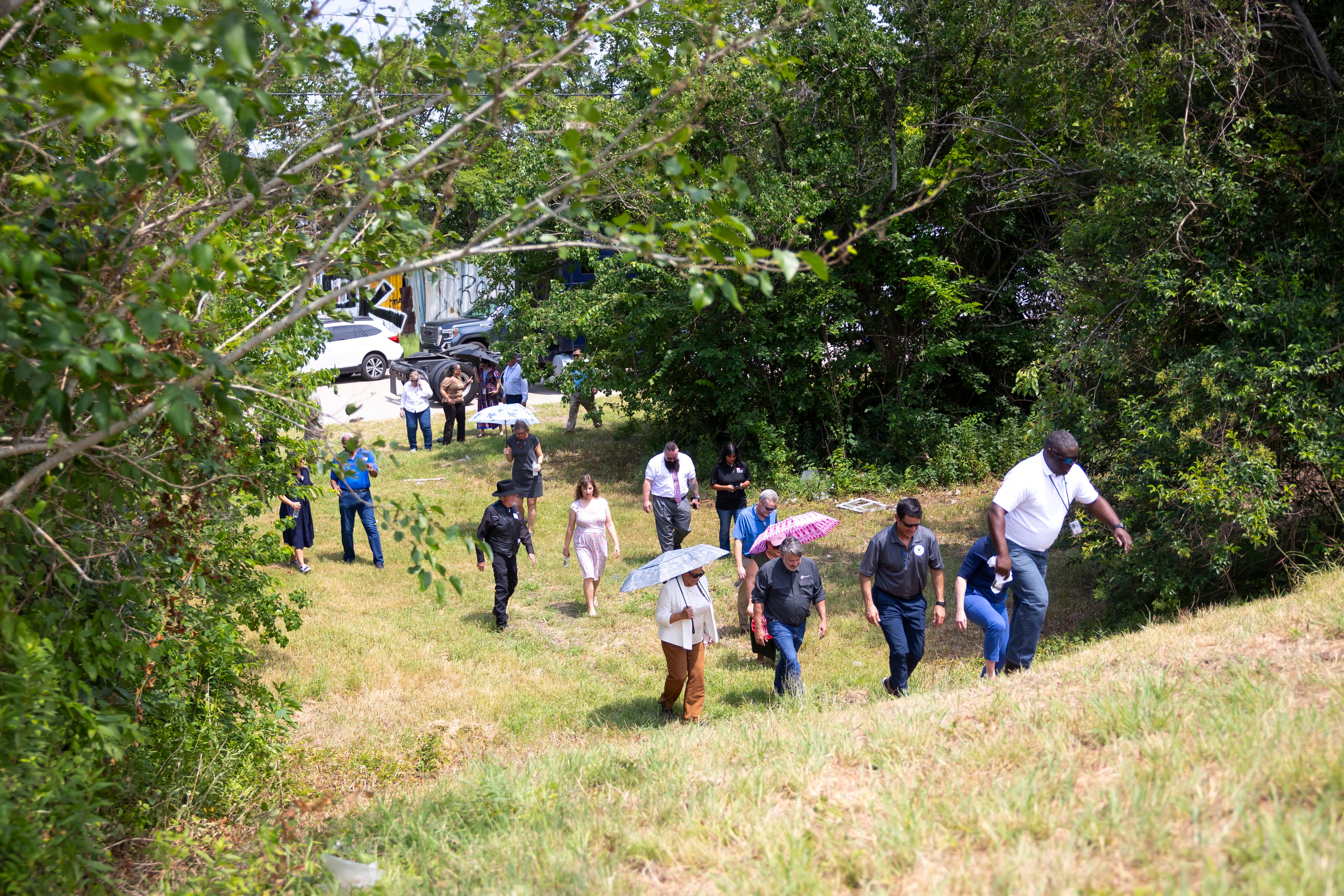
It’s fitting to end this week back in Texas. Houston’s Fifth Ward was once home to the city’s Black Wall Street on Lyons Avenue and was the birthplace of the formidable Barbara Jordan, the first Black person to serve in the state senate before being elected to Congress.
But some of the same injustices Lindsay Heights is fighting were done as well to Fifth Ward. In the 1930s, the community was redlined by the federal government, falsely labeled “hazardous” for investment, starving families of homeownership and generational wealth.
Redlining is a kind of self-fulfilling prophecy. If government maps identify a community solely because of the demographics of its residents as “hazardous,” the actual hazards aren’t far behind. In Fifth Ward, because Houston lacks zoning regulations, too, they took the form of dirty freeways, concrete-batch plants, metal recyclers, warehouses served around the clock by diesel-burning trucks.
Sure enough, childhood asthma rates have spiked nearly twice as high in Fifth Ward as other communities in Houston. At the same time, families are reckoning with the fallout of decades of exposure to cancer-causing creosote, which seeped into a plume underground from a nearby railyard.
Still, they’ve had a hard time getting decision-makers to listen. So, as Dr. Denae King, the associate director of the Robert D. Bullard Center for Environmental and Climate Justice at Texas Southern University, writes in a recent essay, “Community leaders spearheaded a project to install their own air monitors to gather data to back up what they already know: that the air outside their homes, schools and houses of worship is dirty, and it’s harming the health of their residents.”
That community-driven project — one of the first of its kind in Texas — led the state environmental agency to install its own regulatory-grade air monitors, which are powerful and precise enough to collect the official data decision-makers at every level of government can’t ignore.
Even as the Trump administration weakens protections for the air pollutants that have caused such harm in Fifth Ward, the monitors serve as a kind of bulwark, King wrote. “It’s an important step toward Houston families having the information needed to continue their advocacy for healthy, safe communities, free from the burdens of toxic pollution.”