


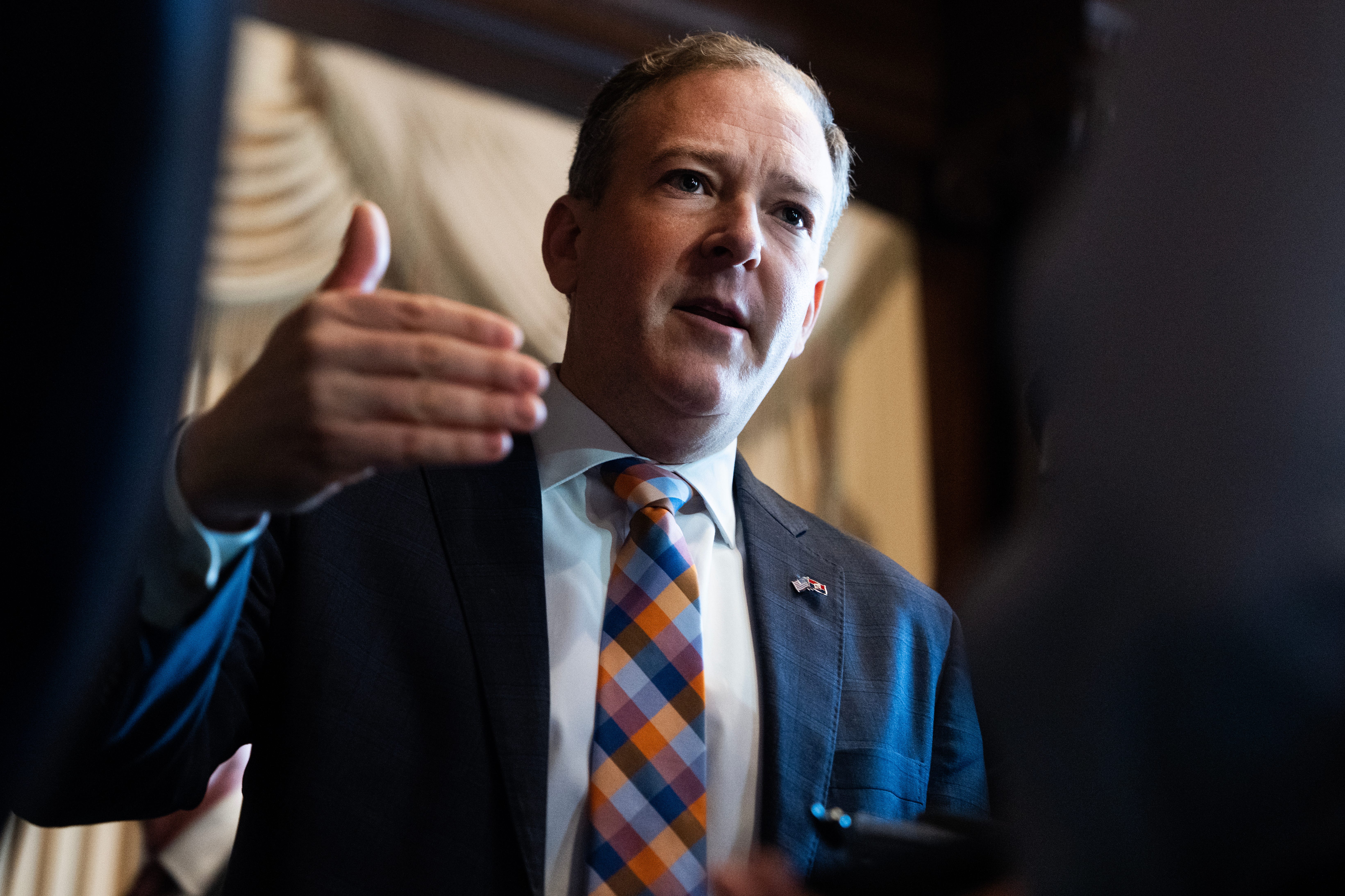
NEXT WEEK, U.S. Environmental Protection Agency Administrator Lee Zeldin is scheduled to appear on the Hill to defend dramatic cuts to his agency. President Trump’s proposed budget calls for a 52% decrease in EPA spending next year, which is like fanning a wildfire that’s already feeding on one of the worst droughts we’ve seen. The agency’s very ability to carry out its mission of protecting human health and the environment is at stake.
Administrator Zeldin spent the past year betraying that mission. His EPA gave away free passes to more than 150 of the country’s largest industrial facilities to ignore environmental laws. It weakened standards for pollutants that cause brain damage and cancer and heart disease. It rejected the very idea that planet-warming pollution even poses a threat.
That’s the opposite of what most Americans want. New polling shows that 63% of adults think the government isn’t doing enough to protect our health and safety. Some are growing increasingly frustrated with the disconnect between what the Trump administration said it would do and what it’s actually doing. Only 35% have a positive rating of our environment, which is even lower than President Trump’s approval rating.
Administrator Zeldin’s EPA went so far as announcing that it would only consider the costs to businesses of compliance when setting pollution standards and no longer place any value on health benefits. It’s another way of saying that your life isn’t worth it. Budgets are moral documents. They reveal priorities. The one Administrator Zeldin will try to defend next week couldn’t make it clearer that our health and safety is no longer on the list.
Welcome to The Work!
I don’t know about you, but I value my life. I’ve been trying to say as much for Environmental Defense Fund for seven years, now. Before that, I was an editor at the Houston Chronicle, where I co-hosted a podcast and served on the editorial board. This summer, I wrote about the Trump administration’s scheme to throw out the Endangerment Finding, the federal government’s fundamental determination that the pollution driving climate change is harming us. By that point, I’d lived through two hurricanes and five 500-year floods in five years. I’d lived through tornadoes that caused billions of dollars of damage just a few miles from where I had to shelter in place with my daughter. It’s not easy to square these experiences with the insistence that climate change might not be so bad, after all.
It’s personal.
That’s what this newsletter is trying to say. We’re trying to connect everyone’s experiences — the bills we have to pay, the health we worry about, the families we’re trying to raise, the places that matter to us — with the climate and environmental policies and politics that get debated in Washington, D.C., and state capitals every day. It all might start there, but it ends up right in the middle of our lives. Please send me an email if you ever have a story you want to share or just want to connect. I can’t thank you enough for reading!
More American exceptionalism?
This year, clean energy met all new demand and overtook coal as the leading source of electricity in the world, according to a new third-party analysis reported by Axios.
In the U.S., though, even as electricity prices spiked and job numbers slumped, the Trump administration insisted on another kind of American exceptionalism, what one federal judge called an “arbitrary and capricious” series of actions to keep cheap wind and solar energy off public land.
With these actions alone, the administration held up enough new electricity to power 50 million homes, Canary Media reported, and caused “$905 million in sunk investment.” It’s not the first time a judge has chosen the words “arbitrary and capricious” to describe one of the Trump administration’s unlawful actions against clean energy, as Canary Media detailed:
“The ruling is the latest in a string of legal losses for the Trump administration, which in the past year has tried but failed to halt construction of offshore wind farms, freeze federal funding for electric-vehicle chargers, and cancel millions of dollars in federal grants for clean energy projects based on the states in which award winners were located.”
“This is what it looks like when ideology drives energy policy,” one editorial board wrote in January. “You cannot weaponize these things and just for political purposes put your thumb on the scale,” Oklahoma Gov. Kevin Stitt said. But that’s what’s happening:
“The Trump administration has been burying solar and wind projects in red tape instead of lowering costs for the American people. While officials have tried to unfairly delay and cancel clean energy projects at every turn, they have rolled out ‘concierge, white-glove service’ for coal and other polluting fossil fuels, opening millions of new acres of public land for coal mining and forcing families to pay for unreliable, expensive coal plants indefinitely.”
— Ted Kelly, EDF
For Your Tabs
Texas’ Gulf Coast has a health problem: benzene emissions are among the highest in the nation | Capital & Main
The inside story of five days that remade the Supreme Court | The New York Times
Clean energy could lower electricity costs — if the Trump administration would stop blocking it | Vital Signs
Stories from the States
Pennsylvania
After pulling Pennsylvania out of an 11-state program that was successfully cutting the amount of planet-warming pollution coming from power plants and growing regional economies, Gov. Josh Shapiro said this week that two of the state’s planet-warming, coal-burning power plants would be skipping their planned retirements, provided they pay daily fines for their ongoing violations of federal wastewater pollution standards. President Trump was quick to praise Gov. Shapiro’s decision as a win for “the fantastic people of Pennsylvania,” but they’ll be the ones who end up paying for this, too. So far, the Trump administration has prevented coal plants in four other states from retiring. When this happens, a member of the White House’s National Energy Dominance Council recently admitted, “all costs end up on ratepayers.” In Colorado, those costs have reached $20 million, even though there’s so much available electricity on the grid that the plant hasn’t been needed. In Michigan, the costs are up to $135 million with no end in sight. Who wins, then? Keeping these coal plants “on life support will not make electricity more affordable for families and businesses,” EDF’s Kelly said. “What Pennsylvanians can’t afford is an energy policy stuck in the past.”
Texas
Won’t somebody please think of the orphan oil and gas wells? Texas has 11,000 of them just sitting there, no longer producing much of anything but pollution and needing to be plugged to keep from leaking and exploding. They’re risky enough, The Texas Tribune reported, but one ranch owner has been battling a state regulatory agency that allows potentially thousands more would-be orphan wells that are producing only “a teaspoon” of oil and gas to drip along out of sight for years instead of deactivating them and dealing with the mess. The ranch owner said she has five of these essentially useless, forever hazardous wells on her property. They often leak a salty brine called “produced water” she worries is contaminating the groundwater she and her livestock drink. Faulty electricity lines at similar wells in other parts of the state have also sparked wildfires that burned more than a million acres. Other states have taken action to require their low-producing wells to be plugged, but Texas’ hands-off approach remains “widely abused,” EDF’s Adam Peltz said. “There’s no reason why the public should bear the risk.”
New York
EDF’s Kate Boicourt is a New Yorker. Now, she’s watching Gov. Kathy Hochul balk at a program that would grow the state’s economy while cutting the planet-warming pollution that’s making extreme weather more destructive. We’ll give the last word this week to Kate:
“Gov. Hochul has cited affordability concerns and federal headwinds as the reason for the changes she’s proposed to our state’s climate law. But that’s at odds with the state’s own prior analysis and other independent assessments, not to mention EDF’s. A well-designed cap-and-invest program, a centerpiece of the law, would lower costs, delivering $1,000 in net savings to 85% of New York households in the years to come and generate $13 billion in health benefits. We are already paying for our dependence on volatile fossil fuels, which have cost New Yorkers an additional $900 million in gasoline and diesel since late February. Gov. Hochul’s proposal would fundamentally weaken the law and knock these benefits off the table. New York has long been a bellwether for U.S. climate policy. We’re working hard with elected leaders to maintain the core tenets of the law. But Gov. Hochul is risking sending a troubling signal at a moment when state leadership has never been more important.”