


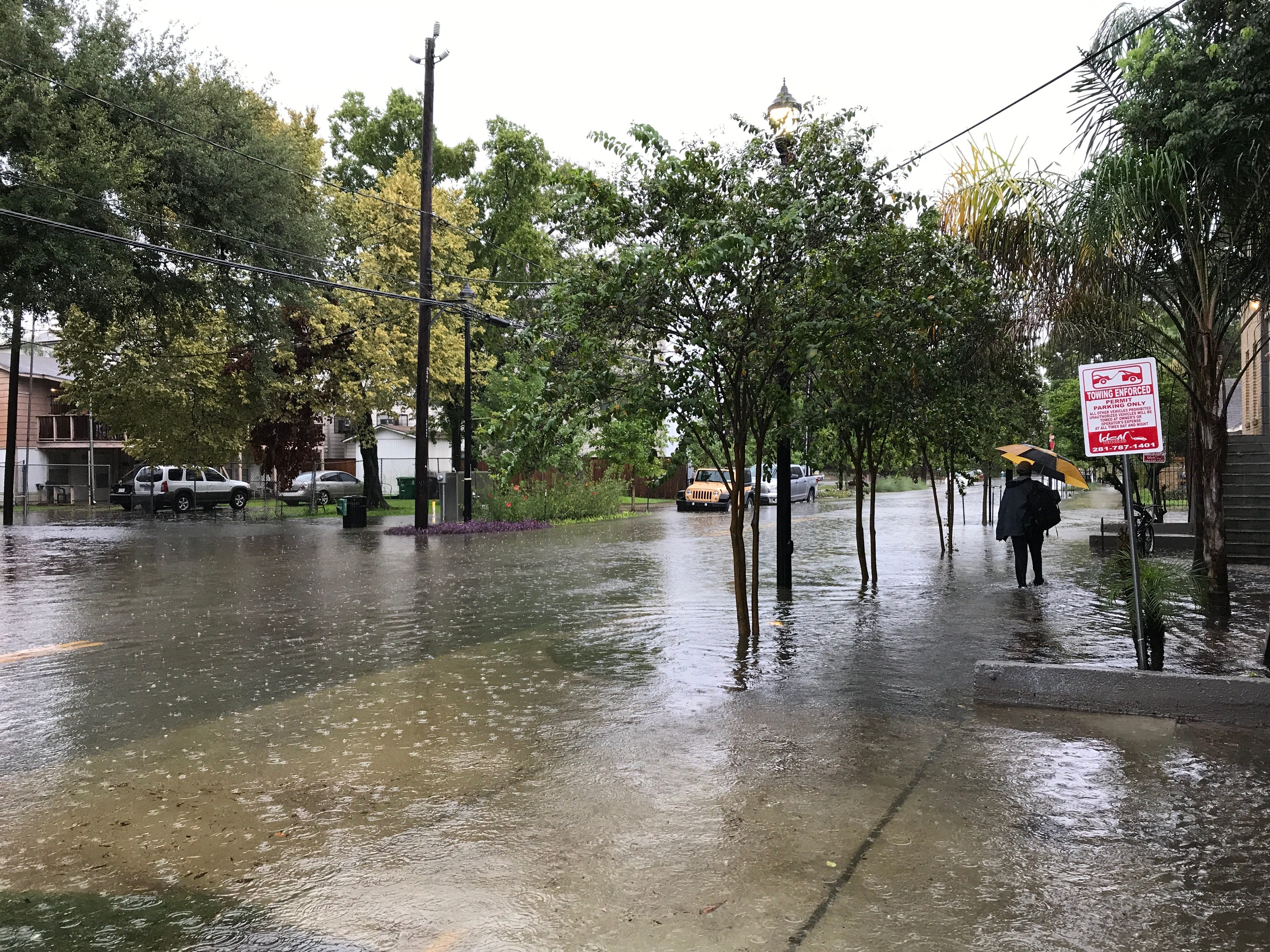
NOT EVERYONE CELEBRATES HURRICANE SEASON. David Richardson, one of many people President Trump has appointed to serve as the acting head of the Federal Emergency Management Agency who’s since left, reportedly told his staff he didn’t even know the U.S. had one.
It starts every June 1. Colorado State University researchers estimate “below-normal” activity this hurricane season, though anyone who’s lived through one knows one is all it takes.
And what’s normal, anyway?
The U.S. had been hit with 403 billion-dollar climate disasters until the Trump administration stopped keeping track last spring. (It’s up to 426 now, Climate Central has found.) These disasters have touched every part of the country. And climate change is penetrating into every part of our lives. What’s different this year is that the Trump administration officially dismissed the idea that any of it is a threat to anyone’s health and safety.
In February, President Trump and U.S. Environmental Protection Agency Administrator Lee Zeldin announced that they’d rescinded the Endangerment Finding. (A lawsuit challenging it was filed almost immediately.) Administrator Zeldin, whose hometown saw 100,000 homes damaged by Hurricane Sandy, vowed to “drive a dagger” through the Endangerment Finding, like 100-mph winds piercing your boarded-up windows with shards of your neighbor’s gutters.
After the Supreme Court ruled in 2007 that the EPA has the obligation and authority to regulate climate-altering pollution, the agency issued the Endangerment Finding, which is just what it sounds like. It’s based on mountains of scientific evidence that has only gotten stronger: the pollution that’s altering the climate is harming us, too. Our health and safety are being threatened.
This year, though, the Trump administration has gone much further than denial. What’s different this hurricane season is that the administration has been busy keeping resources from communities, politicizing the rebuilding process and leaving the entire country less informed and less prepared.
First, billions of dollars in disaster preparedness and recovery funding have been cut, cancelled, frozen and delayed, Sarah Henshaw, my colleague at Environmental Defense Fund, told me.
Second, even though we suffered the costliest six months of climate disasters in U.S. history last year, FEMA has been left to face this hurricane season with its smallest disaster workforce since 2021.
Third, at the same time, the administration has recommended shifting the responsibility for disaster preparedness and response onto limited state and local governments while leaving resources in such bureaucratic and legal limbo none can be sure how much federal help might be available.
Here’s hoping hurricane season itself treats us much, much more gently.
‘I think it’s a mistake’
The scale of loss alone contradicts what New York Gov. Kathy Hochul has been arguing for months. It’s too expensive for New Yorkers, the governor has insisted, for the state to limit the climate pollution that’s making life more expensive.
This week, the state legislature followed her lead and voted to weaken requirements for cutting climate pollution over the next 14 potentially dangerous hurricane seasons — er, years. “I think it’s a mistake,” Assemblymember Jeffrey Dinowitz, who represents The Bronx, said, “and I think that people down the road will pay for this dearly.”
That stands to reason, as people are already paying dearly. Nationwide, electricity prices have increased by 18% since President Trump took office after promising during his campaign that he’d cut them in half. The increase is being driven in part by the volatile cost of fossil fuels like natural gas, which surged to a four-year high this winter during a cold snap when people were trying to stay warm.
At the same time, the risks posed by extreme weather that climate pollution is making more intense are driving up the cost of home insurance. In Erie County, where Gov. Hochul was born, the average cost of insurance has increased by 35% since 2018. In Nassau County, where Administrator Zeldin grew up, it’s increased by 33%, The New York Times reported. It tends to be worst in the most disaster-prone parts of the state.
“The reality is that fossil fuels pollute the air we breathe and are more expensive and less reliable than ever,” Kate Boicourt, my colleague at Environmental Defense Fund in New York, said. “Weakening our climate law prolongs this dirty, expensive cycle, and will saddle communities with higher bills and more pollution.”
The Trump administration’s decision to stop enforcing a standard that was incentivizing oil and gas operators to stop wasting methane is creating the exact same outcome: higher bills, more pollution. Since then, more than $5.3 billion worth of natural gas and counting has vanished into thin air when demand for energy has never been higher:
Add to Your Tabs
The grid is in better shape this summer. Thank solar and batteries. | Canary Media. Jeff St. John:
“The report contradicts the Trump administration’s claims that aging fossil-fueled plants are needed in order to prevent blackouts. Over the last year, the Department of Energy has forced five coal plants and one oil- and gas-fired power plant to stay online past their planned retirements, citing an energy emergency that grid experts say does not exist.”
As data centers boom, Virginians breathe the exhaust of 10,000 diesel generators | Washington Post
Less control, more toxic substances?
One thing the Trump administration has consistently delivered for the American people is more pollution. It’s clear that public health isn’t going to become a priority anytime soon. In January, Trump’s EPA said as much when it abruptly stopped considering the value of lives saved when setting pollution standards. Now, his agency’s interested only in the costs to businesses of complying.
It’s hard to conclude that businesses aren’t also being given special treatment in the partisan campaign to rewrite the Toxic Substances Control Act. After career chemical industry lobbyists were elevated into leadership roles inside EPA, the push got even stronger to influence Congress to weaken the law so chemicals could be rushed into use in everyday products before they’re determined to be safe.
But it’s a lot like listening to your 15-year-old argue that she should be allowed to drive her friends around on the weekends before she gets her license. It’ll be fine. Trust me! You’d tell her to get real.
And that’s more or less what Theresa Watts wrote in a recent op-ed in the Las Vegas Sun. Watts, a registered nurse and assistant professor in Reno, is taking a red-eye on Monday to Washington, D.C., to tell lawmakers that more toxic substances and less control is not what most Americans want.
New polling last fall found that 92% of voters believe that safe drinking water and clean air should be public health priorities. The Toxic Substances Control Act itself is also universally popular, regardless of party affiliation, gender, race, age and education level, with 82% of Americans favoring it as it stands. Ahead of her trip across the country to show up for people’s health, Watts shared her perspective with The Work:
“I’ve seen it firsthand as a nurse working with cancer patients. This disease emotionally drains families and health care providers alike and leaves everyone physically exhausted. Patients can be left wondering: How did I get this? We never want the answer to that question to be that it was from a preventable chemical exposure. We should be able to trust that the chemicals in the products we rely on every day — our phones, our furniture, our children’s bath toys — won’t make us sick.”
Next month marks 10 years since the version of the Toxic Substances Control Act that’s now being threatened was signed into law. We’ll have updates here next week from all the activity on Capitol Hill.