


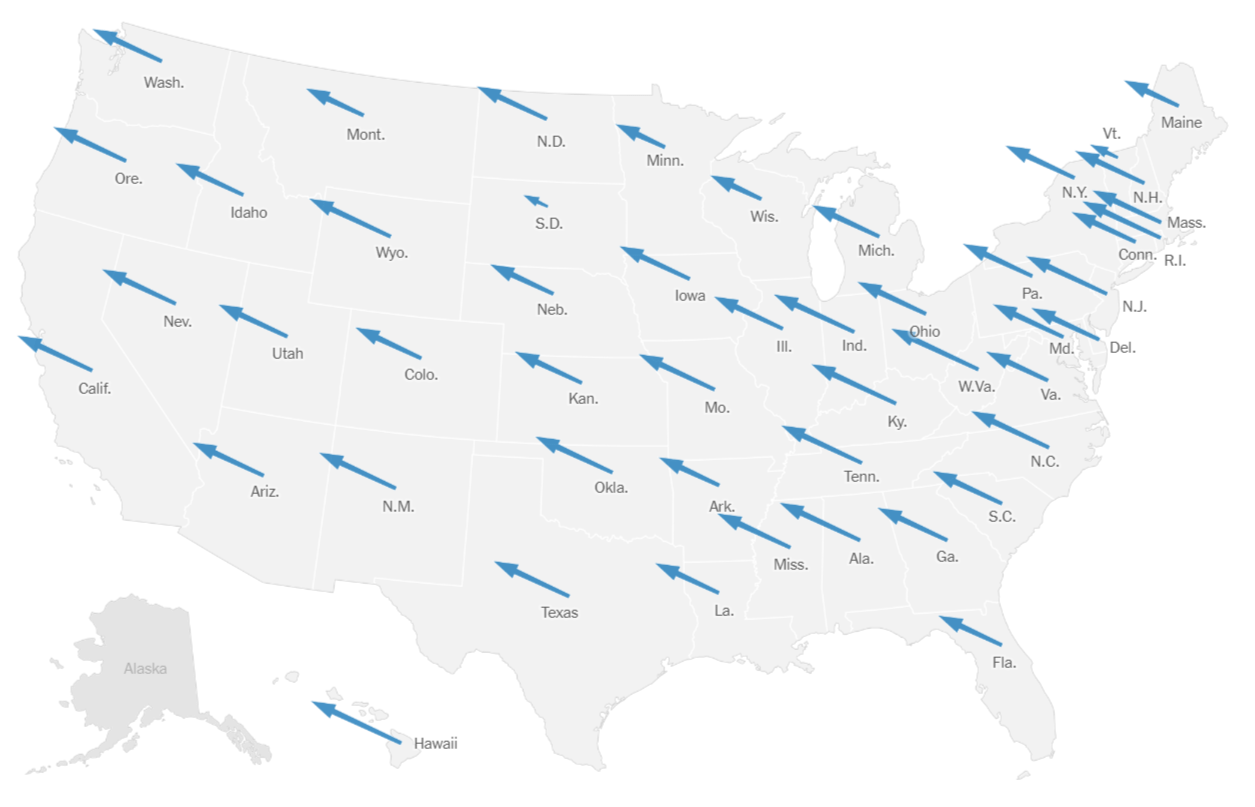
I woke up Wednesday morning worrying about the arrows. Because, for every car honking in Austin, Texas, late Tuesday night, wasn’t there someone sighing alone at her cubicle two years ago? Didn’t the highs I saw all over social media just mirror the lows from 2024? This is what we saw then:
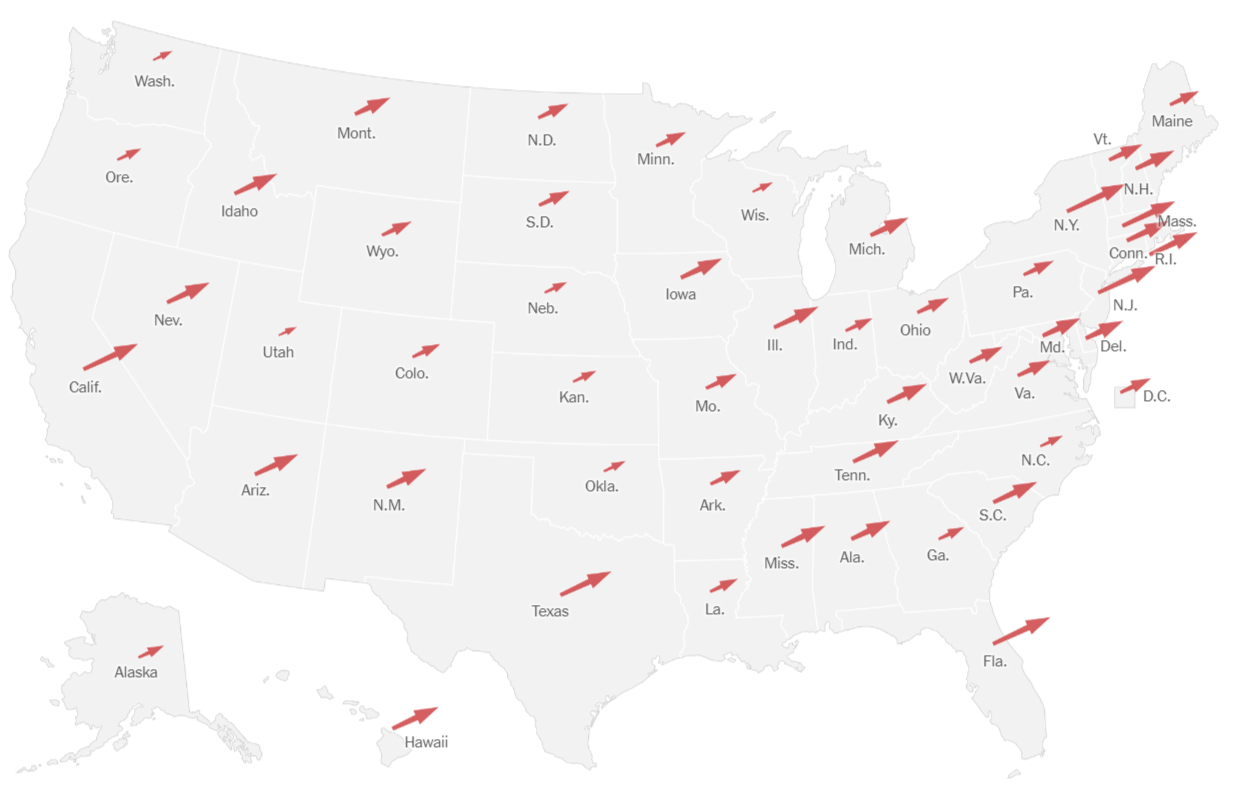
So, I sat down with Joe Bonfiglio, my colleague in D.C. who focuses on U.S. politics at Environmental Defense Fund, to ask him what comes next. Are we trapped on a seesaw of power that’s going to be yanked back and forth every other election? How do we start getting where the arrows are pointing? Our conversation has been edited and condensed for clarity.
AW: The Times’ Peter Baker wrote this morning that it’s the beginning of the end of the Trump era. I wanted to start there. In some ways, the results are a rebuke of the past two years, which have been chaotic and filled with broken promises. But what are some of your takeaways?
JB: Though the Trump administration is not going anywhere, their politics got a resounding thumping last night. President Trump reshaped our politics, through demonizing people and driving division. That fever broke, and voters said they wanted big change.
AW: When you use the phrase “our political moment,” how do you characterize it in your head?
JB: There’s a tension between “today” and “tomorrow” issues in this election. The today issues were front and center, whether it’s how inflation has cut the ability for everyone to afford anything or what the war has done to people’s daily lives.
But I think we also got a sense that people are worried about the tomorrow issues, too. So many people are against data centers who are never going to see one where they live. I think that was rooted in a fear of AI. I don’t think we can ignore that. I don’t think we can ignore that voters saw rampant corruption and self-dealing and connected it to their struggles.
Voters went in very heavily weighted toward trying to fix the today problems, but I don’t want us to look past this worry that is on the horizon, how the country gets stronger, smarter, more economically secure. There really is no scenario where you can continue to double down on old technologies and old ideas, fossil fuels over clean energy.
The policies that have been pushed forward for years weren’t animating before. They’re not going to be animating again. But the climate issue will always lose if there is not a majority of people that believe what is next is good.
AW: What are some of the signs we need to start seeing that we are getting smarter and stronger?
JB: People care about what is happening around them because of climate change. But I would put a flag in the ground. This was not a climate election, and I think I’m pretty safe in saying that, right? But I do think this was a signal better than anyone could have manufactured that the status quo is simply not tenable for a wide swath of the American electorate.
That is hard to explain away. Every demographic group shifted. You can’t explain what happened in this election purely on turnout, which means that people who have never considered voting for Democrats were like, I don’t like what I’m doing, but I’m going to give it a whirl.
So, this is an inflection point. People are looking for what’s next and how it benefits them. Look at those arrows. Those arrows turned blue in rural farm country further, faster than I think anybody assumed was even possible. The through line was that something has to change, but there’s no agreement on what it needs to change to. I think that’s the white space, if you will, that exists.
No deal
Voters made it clear just how bad things have gotten for them, anyway, but “it’s a good time to be a coal plant,” The Guardian wrote.
Over the last two years, as many as 90 coal plants in the U.S. have “received support from the Trump administration through cash handouts, free passes to pollute and requirements to stay online past their retirement dates,” a new Environmental Defense Fund analysis found.
All the support adds up to $950 million in taxpayer money that has been used to impose almost $600 million in new costs and $860 million in health harms back on taxpayers, as my colleague Lexi Ambrogi wrote last week.
In Michigan, for example, one of the Trump administration’s “requirements” for a coal plant to stay open past its retirement date has introduced $615,000 in new costs every single day. With household electricity prices already surging, customers in 11 states have also been shouldering these extra costs for longer than a year now. As Surbhi Sarang, a clean air attorney at EDF, told The Guardian, “It’s like Americans are getting hit twice.”
Much more than ‘trivial’
Ahead of Election Day, a coalition of major environmental groups including EDF delivered hundreds of pages of comments detailing the “numerous legal and technical flaws” in the Trump administration’s proposal to give up limiting heat-trapping carbon pollution from power plants.
When Trump’s EPA issued the proposal this fall, the agency tried to claim that the extra pollution “would have no more than a trivial effect” on people’s health, Heatmap reported.
But the environmental groups checked the EPA’s work, employing new expert modeling along with some of the agency’s own projections, and estimated that it would actually create at least $20.4 trillion in new health harms, which would nearly negate a year of the entire country’s current economic output.
“Trivial,” the EPA tried to claim, would be the 100,000 extra childhood asthma cases, 22,000 hospital or emergency room visits and 1.8 million lost school days by 2100. Such a proposal, the groups wrote, “misinterprets the Clean Air Act, ignores scientific evidence, and entirely misunderstands [EPA’s] own duty as the agency responsible for protecting public health and the environment.”